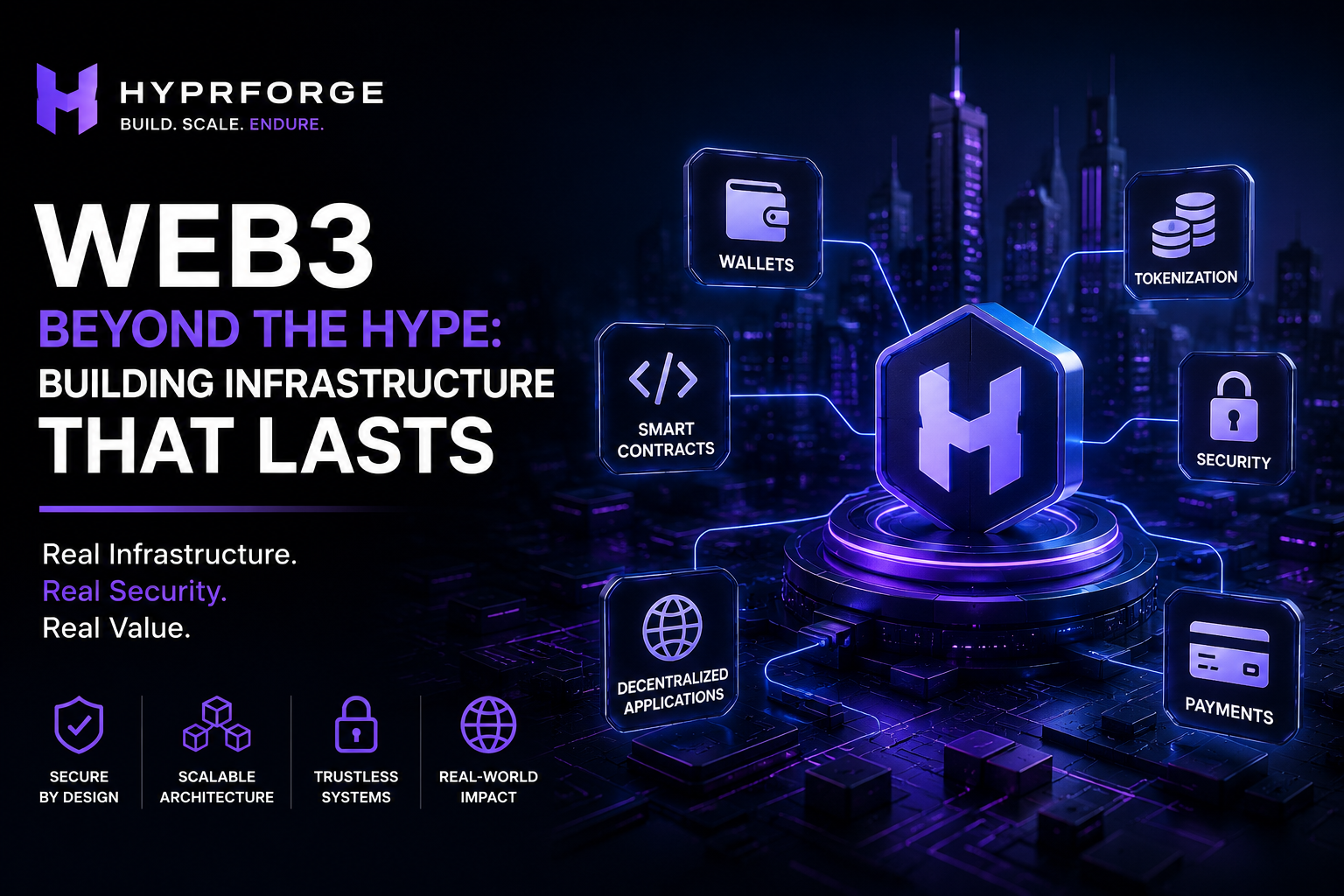
Web3 is moving beyond speculation and into a phase where real infrastructure, security, and usability matter more than headlines.
For businesses exploring blockchain, the challenge is no longer simply “Should we use Web3?” The real question is: How do we build Web3 systems that can survive real-world demands?
From Proof of Concept to Production
Many Web3 projects begin with an exciting idea: a decentralized application, digital asset platform, tokenization system, or blockchain-based payment solution.
But taking that idea into production requires much more than connecting a wallet to a smart contract.
Production-grade Web3 infrastructure needs:
- Secure wallet and authentication architecture
- Reliable smart contracts
- Scalable blockchain infrastructure
- Robust API and backend systems
- Transaction monitoring and observability
- Strong data and access controls
- Seamless Web2 and Web3 integration
- Clear recovery and failure-handling mechanisms
The difference between a prototype and production software is engineering discipline.
Security Cannot Be an Afterthought
In traditional software, a vulnerability can often be patched after deployment.
In Web3, mistakes can become significantly more expensive because blockchain transactions may be irreversible.
That makes security part of the architecture from day one.
Smart contract design, key management, transaction validation, permission systems, infrastructure security, and continuous monitoring all need to work together.
A secure Web3 product isn’t simply one that passes a smart contract audit. It is a system designed with security across every layer of the stack.
Where Web3 Creates Real Business Value
The strongest Web3 applications aren’t necessarily the ones using the most blockchain technology.
They’re the ones where blockchain solves a genuine business problem.
Digital Asset Infrastructure
Organizations can build platforms for issuing, managing, transferring, and tracking digital assets with transparent ownership and programmable rules.
Tokenization
Real-world assets, financial instruments, memberships, and other forms of value can be represented digitally, creating new possibilities for ownership and settlement.
Payments
Blockchain infrastructure can enable programmable payment flows, global settlement mechanisms, and new financial products when implemented with the right compliance and security architecture.
Enterprise Systems
Web3 components can also complement existing enterprise applications rather than replacing them entirely.
The most practical architecture is often hybrid: traditional backend systems handle what they do best while blockchain provides verifiability, ownership, settlement, or programmability where it adds value.
Building for the Long Term
The future of Web3 won’t be defined by how many projects launch.
It will be defined by how many systems continue working when they face real users, real transactions, real security threats, and real business requirements.
At HyprForge, we approach Web3 as an engineering problem—not a trend.
We build systems around security, scalability, reliability, and long-term maintainability, from Web3 wallets and payment infrastructure to tokenization platforms and enterprise blockchain systems.
Because the goal isn’t simply to build something on-chain.
The goal is to build Web3 infrastructure that lasts.
Leave a Reply