In today’s competitive digital landscape, businesses are under constant pressure to launch new products and services quickly. Building everything from scratch, however, can require significant time, technical expertise, and investment.
White-label development offers a practical alternative.
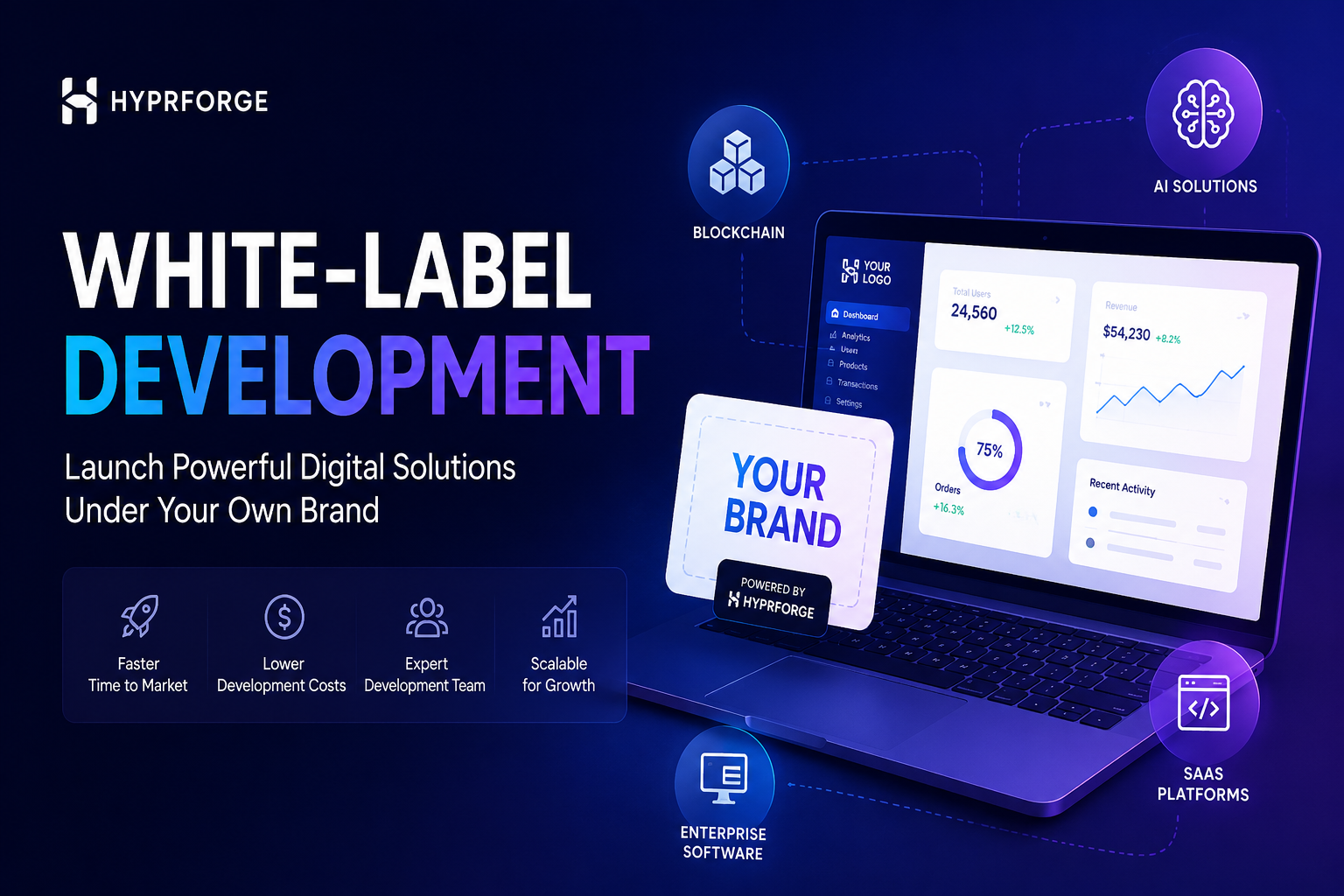
With a white-label development model, businesses can work with an experienced technology partner to build ready-to-brand digital solutions that are launched under their own name. From blockchain platforms and AI applications to SaaS products and enterprise software, white-label development can help companies expand their offerings without building an entire development team from the ground up.
What Is White-Label Development?
White-label development is a model where a technology company develops a digital product or solution that another business can brand, customize, and offer to its own customers.
The development partner handles the technical work, while the client maintains control over the brand, customer relationship, and market positioning.
For example, a software company may want to offer an AI-powered solution but does not have the resources to build the technology internally. Instead of spending months assembling a development team and creating the product from scratch, it can partner with a white-label development company.
The resulting solution can then be customized with the company’s:
- Brand identity
- Logo and colors
- User interface
- Features and workflows
- Domain and customer-facing experience
- Business-specific requirements
This allows businesses to focus more on sales, marketing, and customer relationships while their technology partner handles development.
Why Is White-Label Development Becoming Popular?
The demand for digital products continues to grow across industries. At the same time, businesses want to reduce development timelines and avoid unnecessary technical overhead.
White-label development addresses both challenges.
1. Faster Time to Market
Developing a complex platform from the ground up can take months or even years.
White-label solutions can accelerate this process because development teams can start with established architectures, reusable components, and proven technologies.
This allows businesses to bring products to market faster and respond more quickly to changing customer demands.
2. Lower Development Costs
Building an in-house development team requires more than hiring developers. Businesses may also need designers, project managers, DevOps engineers, QA specialists, security experts, and technical leadership.
White-label development provides access to an experienced team without requiring the same long-term infrastructure.
This can make launching new digital products more cost-effective, particularly for startups and businesses entering new technology markets.
3. Access to Specialized Expertise
Technologies such as artificial intelligence, blockchain, cloud computing, and Web3 require specialized knowledge.
A white-label development partner can provide access to developers and architects who already have experience working with these technologies.
Instead of spending months building internal expertise, companies can leverage an existing technical team.
4. Scalable Product Development
A good white-label solution should not simply work for the first version of a product. It should also provide a foundation for future growth.
Businesses can start with a core product and gradually introduce additional functionality, integrations, automation, and infrastructure as their customer base grows.
Types of White-Label Solutions
White-label development can be applied to a wide range of technologies.
AI and Machine Learning
Businesses can launch AI-powered products without developing their own AI infrastructure from scratch.
Examples include:
- AI chatbots
- AI customer-support platforms
- AI content systems
- Recommendation engines
- AI automation tools
- Custom AI assistants
- Enterprise AI platforms
Blockchain and Web3
White-label blockchain development enables businesses to offer blockchain-powered products under their own brand.
Potential solutions include:
- Crypto wallets
- Tokenization platforms
- Decentralized applications
- Smart contract platforms
- NFT platforms
- Blockchain payment solutions
- Web3 infrastructure
SaaS Platforms
Companies can launch branded software-as-a-service products using customizable white-label platforms.
These solutions can be adapted to specific industries, workflows, and customer requirements.
Enterprise Software
White-label development can also support enterprise applications such as business management platforms, customer portals, workflow automation systems, and custom software solutions.
White-Label Development vs. Building In-House
Both approaches have advantages, but the right choice depends on a company’s resources, timeline, and technical requirements.
| Factor | White-Label Development | In-House Development |
|---|---|---|
| Time to market | Usually faster | Often slower |
| Initial investment | Lower | Higher |
| Technical expertise | Provided by partner | Must be hired internally |
| Customization | High, depending on solution | Very high |
| Team management | Partner-managed | Internal responsibility |
| Scalability | Can scale with the partner | Requires team expansion |
For companies that already have a strong engineering organization, in-house development may make sense.
For companies that want to launch quickly without building a large technical team, white-label development can be an efficient alternative.
What Should Businesses Look for in a White-Label Development Partner?
Choosing the right development partner is critical. A white-label solution becomes part of your brand, so the quality of the underlying technology directly affects your customers’ experience.
Technical Expertise
Look for a team with proven experience in the technology required for your product.
For example, an AI product may require expertise in machine learning, APIs, cloud infrastructure, and data engineering, while a blockchain product may require smart contract, wallet, and Web3 expertise.
Customization Capabilities
Avoid solutions that provide little control over branding and functionality.
A strong white-label partner should be able to adapt the product to your business requirements rather than forcing your business to adapt to a rigid platform.
Security
Security should be a priority, particularly for products handling financial data, customer information, authentication, or blockchain assets.
Development teams should follow appropriate security practices throughout architecture, development, testing, and deployment.
Scalability
The platform should be designed with future growth in mind.
A solution that works for 100 users but struggles with 100,000 users can become a major business problem.
Ongoing Support
Launching the product is only the beginning.
Businesses should consider whether the development partner can provide maintenance, upgrades, bug fixes, security updates, and feature development after launch.
The Future of White-Label Development
As businesses increasingly adopt AI, Web3, automation, and cloud technologies, the demand for specialized digital products will continue to grow.
At the same time, not every company wants to become a technology company internally.
White-label development bridges this gap by allowing businesses to access advanced technology while maintaining their own brand and customer relationships.
The model is likely to become particularly valuable for companies looking to experiment with emerging technologies, launch new revenue streams, or expand their existing product portfolios.
Final Thoughts
White-label development provides businesses with a way to enter new technology markets without taking on the full cost and complexity of building everything internally.
From AI and blockchain to SaaS and enterprise software, the right white-label development partner can help turn an idea into a market-ready product faster and more efficiently.
The key is choosing a partner that combines technical expertise, customization, security, scalability, and long-term support.
For businesses looking to expand their digital offerings while keeping development efficient, white-label development can be a powerful strategy for turning technology into a competitive advantage.
HyprForge helps businesses build scalable AI, Web3, blockchain, and software solutions through flexible development partnerships designed around their business goals.